
What is retinol?
Find out whether you should add retinol to your daily skincare routine!
- Retinol is one of the most effective and most popular ingredients for smoothing visible wrinkles and fine lines and reducing hyperpigmentation.
- It can also reduce breakouts by supporting cell renewal.
Retinol – a retinoid, or form of vitamin A – is without doubt the best the industry has to offer against signs of skin aging. It can speed up skin renewal and reduce wrinkles, fine lines and age spots, while firming and smoothing the skin and evening out its tone. Retinol can also help reduce breakouts, as it helps prevent pores from becoming clogged with dead cells.
why is retinol used?
Skin ages for many reasons, from environmental factors and stress to natural aging. As skin ages, cell renewal and collagen production slow down. Visible signs of aging (spots, fine lines, wrinkles and so on) appear as a result of the skin’s natural defense mechanism, but also because cell renewal and regeneration slow down. Retinol is a great choice for treating signs of premature aging because it speeds up cell renewal and so softens the signs of aging.
how does retinol work on the skin?
Retinol supports skin cell renewal and regeneration, giving the skin a smoother look and a more even tone. For the skin to tolerate retinol, however, it first has to build up what are called retinoid receptors. These receptors are proteins that occur naturally in the skin and help retinol do its job. Skin can build up retinoid receptors through controlled exposure, which is why it is often recommended to start with retinol products carefully and gradually work up to higher concentrations.

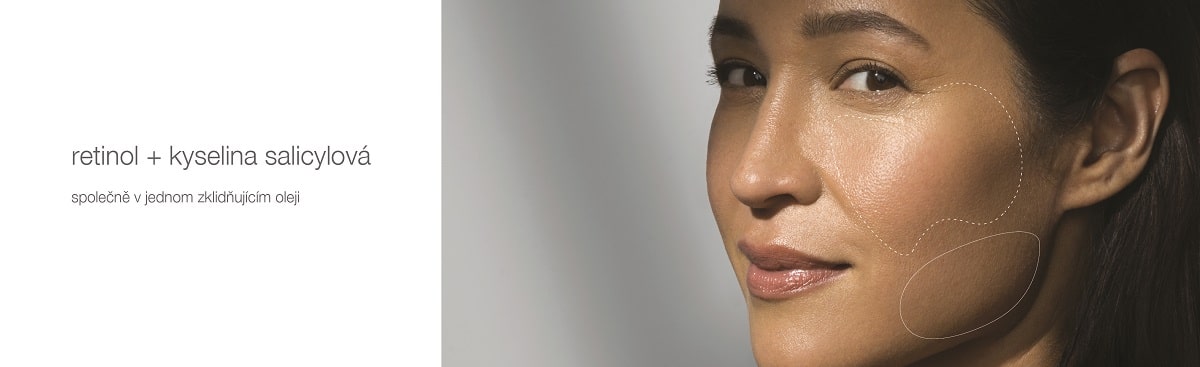
New! Retinol Clearing Oil combines two powerful actives in one formula for the first time: salicylic acid, which quickly clears breakouts and helps prevent new ones, and an effective time-released retinol that helps reduce the look of fine lines, wrinkles and hyperpigmentation. Best of all, this high-performance night oil renews and clears the skin overnight and reduces signs of premature aging within 7 days.
what types of retinol are there?
Retinol belongs to the retinoids, forms of vitamin A that help speed up cell renewal and skin regeneration, effectively even out skin tone and smooth damage caused by skin aging.
Retinoids have their strongest effect on collagen! They play a double role: they help reduce collagen breakdown after sun exposure and at the same time stimulate the production of new collagen.
- Retinoic acid is a type of retinoid available on prescription, for example as isotretinoin and tretinoin, but it carries the highest risk of skin irritation.
- Retinol is the strongest retinoid available without a prescription. Although it is also very effective, retinol is about 20% weaker than retinoic acid, and the skin slowly converts it into retinoic acid itself. This also means it carries a lower risk of irritation than retinoic acid.
- Retinyl palmitate, retinyl propionate and retinyl acetate are the weakest types of retinoids, also known as retinol esters. They take longer to convert into retinoic acid, but the risk of skin irritation is minimal.
- Microencapsulated retinol. Some forms of retinol are microencapsulated, which stabilizes the retinol and ensures maximum effect. Microencapsulated retinol also forms an invisible shield on the skin’s surface that helps reduce moisture loss, which is essential for reducing wrinkles and fine lines.
how to use retinol
- Start using retinol carefully: letting your skin build up tolerance gradually helps prevent irritation. Start once a week, then every other day, and finally move to daily use.
- Apply retinol at night to avoid sun-related irritation.
- Always use an SPF moisturizer during the day to protect your skin from the sun.
- Do not use other exfoliants unless they are designed to be used together with retinol in one product, or unless your skin therapist or doctor approves them.
- Do not use retinol if you are pregnant or breastfeeding.
does retinol cause peeling, breakouts or redness?
It can take your skin several weeks to get used to retinol. During this time, you may notice flaking, small breakout-like bumps and other forms of irritation. This is normal and should stop once your skin has built up enough retinoid receptors. Some people call this “purging”, but in reality it simply means that your skin is building receptors through controlled exposure.
does retinol cause dark spots?
Retinol does not cause age spots (hyperpigmentation); on the contrary, it is used to reduce their appearance. However, retinol makes the skin more sensitive to sunlight, so while you are using retinol products you should apply and reapply an SPF moisturizer. Any sun damage can halt your progress and lead to more spots and other signs of aging.